




|
Quantity
|
Total
|
||
|
|
|||
|
|
|||
Carpenter & Framing Chisels for Mortising and Heavy Joinery
Heavy woodworking requires a different kind of chisel.
When cutting mortises, cleaning deep joints, fitting structural timber or removing substantial waste, a lightweight carving chisel can flex or feel unstable under repeated mallet blows.
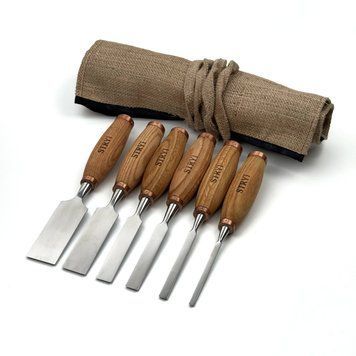
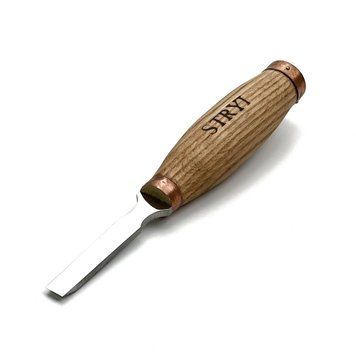
STRYI Carpenter & Framing Chisels are built for demanding woodworking where strength, edge control and leverage matter. Their heavy flat blades are designed for deep joinery, timber framing, carpentry and other operations that require controlled material removal under load.
The current STRYI Heavy-Duty Flat-Beveled Carpenter Chisel is specifically intended for mortising timber frames, heavy carpentry and large-scale woodworking, with a reinforced 5 mm blade and mallet-ready construction.
What Are Carpenter Chisels Used For?
A strong flat chisel is one of the basic tools for structural woodworking.
Typical applications include:
- cutting and cleaning mortises;
- fitting mortise-and-tenon joints;
- squaring corners inside recesses;
- cleaning deep grooves and sockets;
- trimming shoulders and joint surfaces;
- working large structural timber;
- removing waste during heavy carpentry;
- refining flat surfaces after rough stock removal.
Unlike a carving gouge, which is designed around a curved cutting edge, a carpenter chisel uses a flat edge to create straight walls, flat bottoms and clearly defined joint surfaces.
Carpenter Chisel, Framing Chisel or Mortise Chisel?
These terms describe related tools, but they are not completely interchangeable.
A carpenter chisel is a broad term for strong general-purpose woodworking chisels used in construction, fitting and timber work.
A framing chisel is heavier and is designed for structural timber, large joints and mallet-assisted work.
A traditional mortise chisel is specifically optimized for cutting deep, narrow mortises and usually has a thick, narrow blade designed to withstand levering inside the joint.
The current STRYI 160006 tool is best described as a Heavy-Duty Carpenter / Framing Chisel. STRYI also explicitly recommends narrower versions for tight mortises and timber-frame joinery.
That is why I would use mortise chisel as an important SEO term in the text, but I would not rename the entire STRYI category simply “Mortise Chisels.”
Why Blade Thickness Matters
When a chisel is driven into a deep mortise or large timber joint, the blade experiences much more lateral force than during light paring.
A thicker blade provides additional rigidity.
That means:
less unwanted flex,
better control in deep joints,
greater stability under mallet blows,
and more predictable material removal.
This is one of the key differences between a heavy carpenter chisel and a thin relief-carving chisel.
Mortising and Joinery
For mortise-and-tenon work, the chisel has to do more than cut straight down.
It may be used to:
establish the sides of the mortise, remove waste between cuts, clean the bottom and walls, and refine the fit before assembly.
For this reason, edge geometry and blade rigidity are especially important.
The current STRYI product page specifically identifies narrower sizes for precision timber-frame joinery and tight mortises, while medium and larger sizes are intended for increasingly heavy framing work.
Carpenter Chisel vs. Carving Chisel
These tools may look similar, but they are optimized for different work.
A carving chisel is usually thinner and lighter, giving the user greater sensitivity during relief or sculptural carving.
A carpenter or framing chisel is heavier and more rigid because it has to withstand stronger mallet strikes, deeper cuts and structural woodworking.
For delicate relief backgrounds, a standard STRYI Flat Chisel #1 is the more precise choice.
For a timber mortise or heavy structural cut, the reinforced carpenter chisel is the appropriate tool. The STRYI English site makes the same distinction between its precision flat carving chisels and heavy-duty carpenter models.
Professionally Sharpened and Ready to Work
A heavy chisel still depends on a clean edge.
More force should not be used to compensate for poor sharpening. A correctly prepared edge enters the fibers more efficiently and lets the user control the direction of the cut with less unnecessary impact.
STRYI Heavy-Duty Carpenter Chisels are hand-sharpened and stropped before shipping for use in both softwood and hardwood.
Regular stropping helps maintain the cutting edge between full sharpening sessions.
Made in Ukraine, Shipped Worldwide
STRYI Carpenter & Framing Chisels are made in Ukraine for carpenters, timber framers, furniture makers and woodworkers who need a strong flat chisel for demanding joinery.
Whether you are cutting a mortise, cleaning a timber-frame joint or removing waste from a large wooden component, a properly sized carpenter chisel gives you the rigidity and control needed for accurate heavy woodworking.