







|
Quantity
|
Total
|
||
|
|
|||
|
|
|||
Wood Carving Knives – Control Every Cut from Rough Shaping to Fine Detail
A carving knife is one of the most direct tools in wood carving. There is no long shank between your hand and the cutting edge, which means every change in pressure, angle, and direction immediately affects the cut.
That is exactly why the right knife matters.
STRYI Wood Carving Knives are designed for controlled hand carving — from removing material and establishing the basic form to cutting crisp geometric patterns, refining contours, and working on small details. Different blade lengths and geometries allow you to choose a knife for the specific type of cut instead of forcing one blade to perform every task.
Each STRYI carving knife is professionally sharpened before shipping, so the tool arrives ready to work without the need to establish a new cutting edge first.
Which Wood Carving Knife Do You Need?
Wood carving is not a single technique, and different knife shapes solve different problems.
The STRYI range includes knives for:
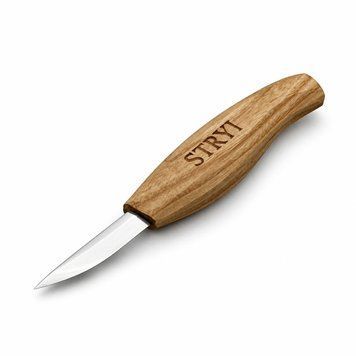
- Whittling and shaping – longer, versatile blades for establishing silhouettes, removing material, and shaping figures, spoons, toys, and other three-dimensional projects.
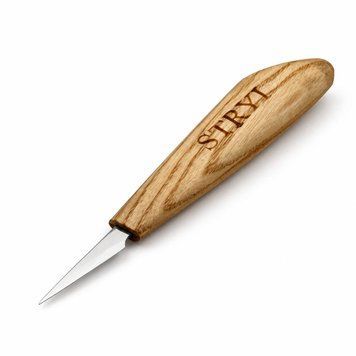
- Detail carving – shorter blades that keep the cutting edge close to your hand for greater control in tight areas and small features.
- Chip carving – rigid, precise blades for geometric patterns, stop cuts, triangles, borders, and decorative cuts.
- Contour carving – controlled blades for following curved lines, outlining ornaments, and creating clean decorative edges.
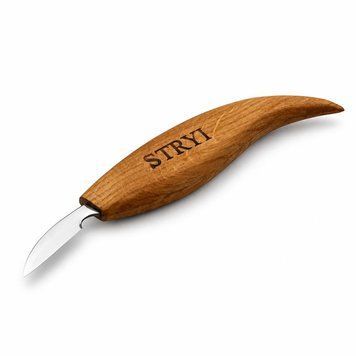
- Skew and angled cuts – specialized blade geometry for reaching corners, making slicing cuts, and refining difficult details.
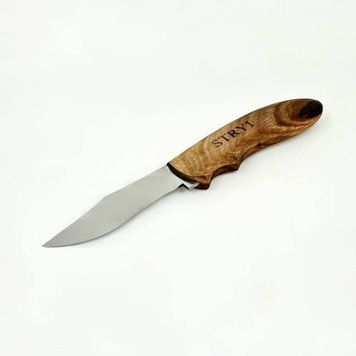
- Sculptural carving – knives that help shape figures, faces, animals, ornaments, and other dimensional forms.
STRYI’s current carving-knife range includes dedicated sloyd, whittling, detail, chip carving, and skewed carving knives, allowing the blade geometry to match the actual carving technique.
Whittling Knife vs. Detail Knife vs. Chip Carving Knife
Choosing a carving knife becomes easier when you start with the type of work rather than the blade size alone.
A whittling or sloyd knife is the versatile shaping tool. Its longer cutting edge works well for slicing cuts, reducing a blank, rounding forms, and creating the overall shape of a carving. STRYI currently uses the Sloyd/Whittling terminology for its 50–80 mm carving knives.
A detail carving knife has a shorter blade that puts your fingers closer to the cutting edge. This gives you more precise control when carving tight corners, small features, stop cuts, and fine transitions. The STRYI 38 mm bench knife, for example, is positioned for both whittling and detailed carving work.
A chip carving knife is designed around precise geometric cuts. Its rigid blade helps track layout lines consistently when cutting triangles, borders, rosettes, and repeating patterns.
In simple terms:
Whittling knife = shaping the form.
Detail knife = refining small areas.
Chip carving knife = precise geometric cuts.
Many carvers eventually keep several knife types at the bench because each geometry gives better control over a different stage of the project.
Why Choose STRYI Wood Carving Knives?
A good carving knife should cut with little unnecessary force and respond predictably to small movements of the hand.
- Professional tool steel – selected for reliable cutting performance and lasting edge retention.
- Ready to carve – knives are professionally sharpened and honed before shipping.
- Rigid blade geometry – helps reduce unwanted flex and blade drift during precise cuts.
- Clean cutting edge – a properly prepared edge slices wood fibers instead of crushing or tearing them.
- Ergonomic hardwood handles – shaped for a comfortable, secure grip and better blade control.
- Different blade shapes and lengths – choose the knife according to whittling, detail work, chip carving, or sculptural shaping.
- Made by STRYI – tools are produced by the manufacturer rather than sourced as generic carving knives.
Current STRYI knife descriptions also emphasize rigid blades and professional hand honing as important for predictable cuts and immediate use.
How to Choose a Wood Carving Knife
Start with three questions:
What will you carve?
For figures, animals, spoons, and general shaping, start with a whittling or sloyd knife. For geometric patterns, choose a chip carving knife. For small features and finishing work, a shorter detail knife gives greater control.
How much material do you need to remove?
A longer blade is more efficient for shaping and slicing cuts. A compact blade is easier to control when the work becomes precise.
How close do you want your hand to the cutting edge?
Short blades provide more immediate control. Longer blades give you more cutting length and versatility for broader shaping strokes.
For a workshop that covers several carving techniques, combining a general-purpose whittling knife with a dedicated detail or chip carving knife is usually more practical than expecting one blade to handle every operation.
Ready to Carve from the First Cut
A carving knife should not require hours of edge preparation before you can find out how it performs.
STRYI knives are supplied professionally sharpened so you can start carving immediately. Regular stropping with a leather strop and honing compound will help maintain the edge between sharpenings and preserve the original blade geometry.
Whether you are learning your first controlled cuts or working on detailed professional carving, choosing the right wood carving knife gives you cleaner lines, better control, and less effort from the first rough cut to the final detail.