

|
Quantity
|
Total
|
||
|
|
|||
|
|
|||
Woodworking & Carving Mallets for Controlled Chisel Work
A good mallet gives a woodcarver something hand pressure alone cannot provide: additional cutting force without sacrificing control.
When roughing a sculpture, cutting deep relief or driving a heavy-duty chisel through dense wood, a properly selected woodworking mallet transfers controlled impact to the tool while being gentler on a wooden chisel handle than a steel hammer.
STRYI Woodworking & Carving Mallets are designed for use with carving chisels, gouges and heavy-duty sculpture tools. The current range includes leather mallets in 75 and 90 mm sizes and rubber mallets in 60 and 70 mm sizes.
When Should You Use a Carving Mallet?
Not every carving operation requires a mallet.
For detail work, shallow relief and controlled finishing cuts, hand pressure is often enough. A mallet becomes useful when the cutting edge needs additional force to enter the wood efficiently.
Typical applications include:
- roughing large wooden sculptures;
- driving heavy-duty chisels and gouges;
- removing substantial waste wood;
- cutting deeper relief;
- working dense hardwood;
- establishing deep grooves and recesses;
- mortising and heavier joinery with mallet-ready chisels;
- shaping large forms where hand pressure would be inefficient.
STRYI's own heavy-duty carving range is specifically designed around mallet-assisted work, while the company recommends making sure the chisel itself is suitable for mallet use before striking it.
Leather Mallet vs. Rubber Mallet
Both transfer impact to the tool, but they feel different in use.
Leather Mallets
A leather mallet provides a firm but comparatively cushioned strike.
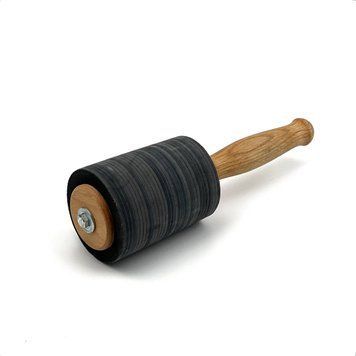
Current STRYI leather mallets use a striking head formed from round genuine-leather segments and an oak handle. They are available in 75 mm and 90 mm versions.
They are particularly suitable for:
- sculpture chisels and gouges;
- repeated carving strikes;
- roughing and shaping large forms;
- situations where the carver wants substantial force with a less harsh impact than a steel hammer.
The larger 90 mm version provides more mass for demanding work, while the 75 mm model offers a more compact option for controlled sculpture carving.
Rubber Mallets
A rubber mallet has a resilient striking surface that produces a softer contact than metal.
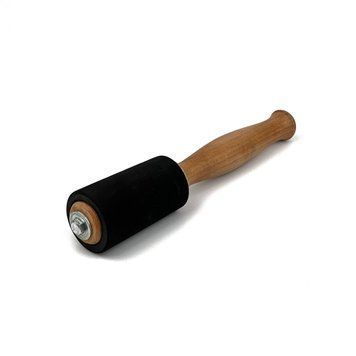
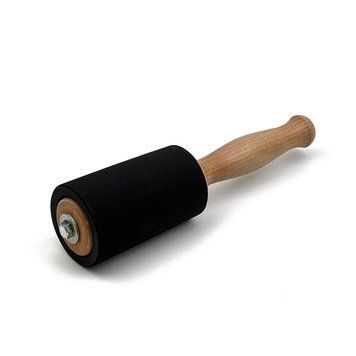
STRYI currently offers 60 mm and 70 mm Rubber Mallets, both with oak handles. The 60 mm model weighs approximately 0.45 kg, while the 70 mm version is approximately 0.75 kg.
Rubber mallets are useful for:
- controlled chisel and gouge work;
- wood sculpture;
- heavier carving where a resilient striking surface is preferred;
- positioning or assembly tasks where direct steel-hammer contact would be undesirable.
Which Mallet Size Should You Choose?
The right mallet is not simply the largest one available.
A lighter mallet requires less effort to accelerate and gives the user finer control over repeated strikes. A heavier mallet transfers more energy with each swing and can make demanding stock removal more efficient.
For practical selection:
60 mm Rubber Mallet – lighter and easier to control for moderate carving work.
70 mm Rubber Mallet – more mass for heavier chisels and stronger cuts.
75 mm Leather Mallet – a versatile leather option for regular sculpture and carving.
90 mm Leather Mallet – better suited to large heavy-duty chisels, substantial stock removal and large-scale sculpture.
The goal is not to hit as hard as possible. The correct mallet should let the cutting edge advance through the wood with controlled, repeatable blows.
Match the Mallet to the Chisel
The size of the carving tool matters just as much as the wood species.
A small standard gouge does not require the same impact as a 50 or 70 mm heavy-duty sculpture gouge.
For lighter tools, excessive mallet force can make the cut harder to control. For large reinforced chisels, an undersized mallet may force the user to swing harder than necessary.
A useful rule is:
lighter tool → lighter mallet and finer control
heavy-duty tool → more mallet mass and stronger energy transfer
STRYI's current guidance specifically recommends mallet assistance for larger chisels and heavy-duty tools when additional force is required.
Why Not Use a Steel Hammer?
A metal hammer creates a much harder point of impact.
Repeated steel-on-wood strikes can damage a wooden chisel handle unless that tool has been specifically engineered for such treatment.
Leather and rubber mallets provide a more appropriate striking surface for woodworking tools because the contact is less severe while still transferring enough energy to the cutting edge. STRYI describes both its leather and rubber mallets specifically as alternatives for striking carving-tool handles without the hard contact of a metal hammer.
This is particularly important with the STRYI Heavy-Duty range, where the tool is engineered for mallet strikes but the objective is still controlled power, not uncontrolled impact.
Better Control During Sculpture Work
A mallet is not only about adding force.
It also lets the carver separate two actions:
one hand establishes the angle and direction of the chisel, while the other controls the amount of energy entering the cut.
This is especially useful when:
- approaching a marked boundary;
- controlling the depth of a recess;
- working around raised relief;
- roughing a large curved surface;
- removing waste without driving the chisel too far.
Several lighter strikes often provide better control than attempting to remove the same amount of material with one excessive blow.
Choose the Mallet for Your Way of Working
Choose a Rubber Mallet when you want a resilient striking surface and a choice between lighter 60 mm and heavier 70 mm formats.
Choose a Leather Mallet when you prefer the feel of a traditional carving mallet made from stacked leather sections, particularly for repeated work with sculpture chisels and gouges.
For large STRYI Heavy-Duty Chisels, Gouges and V-Parting Tools, either type can provide the additional force needed for demanding sculpture work when matched appropriately to the size of the tool.
Made for STRYI Heavy-Duty Carving Tools
STRYI mallets naturally complement the company's Heavy-Duty Sculpture series, including flat chisels, Sweep #5–#9 gouges, V-parting tools and bent gouges.
The current STRYI sculpture collection includes both leather and rubber mallets alongside its mallet-ready heavy-duty carving tools.
Whether you are roughing a large sculpture, cutting deep relief or driving a framing chisel, the right woodworking mallet gives you additional cutting power while keeping the strike controlled and predictable.