




|
Quantity
|
Total
|
||
|
|
|||
|
|
|||
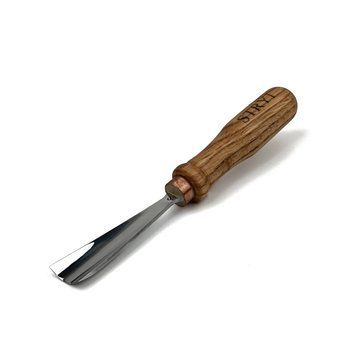
25 mm Gouges for Wood Carving — a tool for large surfaces and bold relief
Not every step in a carved piece calls for a fine tool. When you need to shape a large surface, clear the background around an ornament or change the surface level quickly, a wide blade is the easier choice. The 25 mm gouge is built for exactly that. It works a sizeable area in a single pass and complements a set of narrow tools well.
This width fits large carved parts, decorative panels, furniture elements, wooden overlays and dimensional compositions. It comes in where you first set the overall geometry, then move on to fine detailing.
Where a 25 mm gouge is used — the main jobs in carving
Depending on the profile, a 25 mm gouge can handle several very different operations:
- Clearing background — removing a layer of wood around a raised ornament.
- Cutting large hollows — creating a clear step between separate relief levels.
- Rough-shaping a surface — taking off excess material before finishing.
- Cutting wide flutes — with a semicircular profile.
- Forming smooth transitions — when working with a shallow-sweep gouge.
- Working large ornament elements — leaves, petals, scrolls and other sizeable details.
- Geometric carving — with the special short models made for this type of work.
You don't have to run a 25 mm gouge across the full width of the blank, either. Use it on the specific areas where a cutting edge this wide is what the job needs.
STRYI 25 mm gouges — which option for which technique?
25 mm gouges differ not only in profile but in the character of the cut, so base your choice on the work ahead:
- Semicircular 25 mm — a sensible pick for rounded hollows, wide channels and relief elements with a smooth line.
- Shallow-sweep 25 mm — suits gradual material removal and soft transitions over large areas.
- Short semicircular even-edge — handy for geometric techniques, where a clear tool position and repeatable movements matter.
- Short semicircular skew — used in geometric carving, where the skewed edge helps shape ornament elements.
Each profile has its own place in the workshop. A semicircular model makes more sense for rounded forms, a shallow-sweep one for relief transitions, and a short one for particular geometric-carving techniques.
How to keep a 25 mm gouge in working order
A wide tool is made for serious work, but how long it lasts depends directly on how you treat it. After use, clean wood residue, resin and dust off the cutting edge. Store the 25 mm gouge apart from other metal tools, so the edge doesn't pick up accidental damage.
Sharpening deserves particular attention. On a 25 mm model it's important to keep the original profile geometry. If you change the edge shape at every sharpening, the gouge will gradually stop giving the cut you chose that specific model for.
Don't make up for a dull blade with excess force. Timely sharpening makes the work easier and eases the load on the tool at the same time. For routine care, the right stones and honing supplies are the practical answer.
When working with a mallet, factor in the build of the specific model too. The blow should be controlled and the blank held firmly. That lets you make the most of a wide gouge without needless strain on the cutting edge.
25 mm gouges at a good price at STAMESKI — what to weigh before buying
The price of a 25 mm gouge depends on profile, build and series. So comparing models on cost alone is a mistake: semicircular, shallow-sweep, short, skew and forged gouges all solve different tasks.
At the STAMESKI online store you can pick the right STRYI option for artistic, relief or geometric carving. When a 25 mm becomes part of a professional kit, it pairs well with narrower gouges — the wide tool takes the main volumes, the narrow ones refine the shape and add detail.
Choosing a 25 mm gouge, you can get advice on specific profiles and what each model is for. Orders ship worldwide, and quickly.