




|
Quantity
|
Total
|
||
|
|
|||
|
|
|||
Adolf Yurev Short V-Parting Tools – Crisp Lines for Volumetric Geometric Carving
In geometric carving, a clean line can define the entire pattern. Sharp grooves, precise intersections, shadow lines and clearly separated elements require a tool that follows the intended path without tearing the surrounding wood.
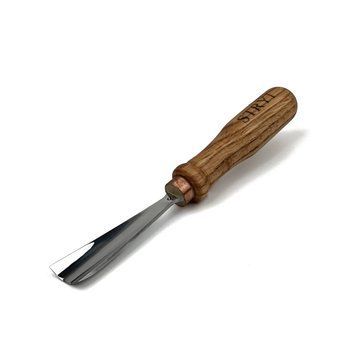
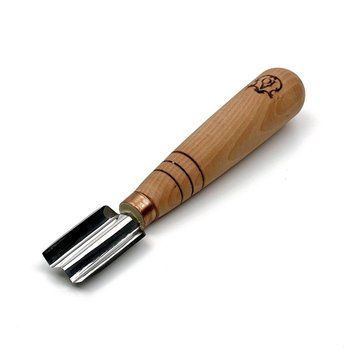
STRYI-AY Adolf Yurev Short V-Parting Tools are designed for this precise work.
Their V-shaped cutting edge creates two clean walls in a single pass, while the compact STRYI-AY geometry keeps the working edge close to the hand. This gives the carver direct control over the direction and depth of the cut — especially useful in tight geometric patterns and three-dimensional relief.
Current STRYI-AY models include straight, skewed and straight-bevel V-parting tools, with 90° profiles used for geometric grooves, corners and volumetric chip carving.
What Is a V-Parting Tool Used For?
A V-tool is not simply a chisel with an angled blade. Its two cutting wings meet at a point and remove a V-shaped channel from the wood.
This makes it especially useful for:
- outlining geometric elements;
- cutting crisp V-grooves;
- defining triangles, facets and borders;
- creating shadow lines between raised elements;
- separating individual parts of an ornament;
- cleaning internal corners;
- carving veins, folds and narrow decorative lines;
- adding depth and contrast to volumetric geometric patterns.
Within the Adolf Yurev system, V-parting tools work alongside Swallowtail knives and short gouges. The knife establishes the primary geometry, the gouge creates rounded volume, and the V-tool defines boundaries and shadow lines.
Straight vs. Skewed V-Parting Tools
The cutting geometry changes how the tool enters and moves through the wood.
Straight V-Parting Tools
A straight V-parting tool is the general-purpose option for cutting regular grooves, outlines and repeated geometric elements.
It is particularly useful when you need predictable, symmetrical V-shaped cuts and consistent line depth.
STRYI currently offers a 90° Short Straight V-Parting Chisel within the Adolf Yurev system for volumetric chip carving and detailed relief work.
Skewed V-Parting Tools
A skewed V-parting tool approaches the wood at an angle.
This geometry makes it easier to reach difficult corners and enclosed geometric pockets and allows more of a slicing action instead of pushing directly into the grain.
The current STRYI-AY skewed model uses a 90° V-profile and is available in several widths for work ranging from fine details to broader decorative cuts.
Straight-Bevel V-Parting Tools
A straight-bevel V-tool provides another cutting geometry for controlled outlines, corners and cleanup work.
Current STRYI-AY straight-bevel models are offered for fine detailing through broader decorative work, with widths including 6, 10, 15 and 20 mm on the present product page.
Why the Short STRYI-AY Geometry Matters
The Adolf Yurev system is built around a deliberately short working section.
This is particularly valuable with a V-tool because the tip must stay accurately aligned throughout the entire groove. Even a small sideways movement can change the width or direction of the line.
Bringing the cutting edge closer to the hand gives you:
- more direct control over the V-point;
- better stability in short, deep cuts;
- easier work inside compact patterns;
- more predictable groove depth;
- less unwanted tool movement;
- easier control when repeating the same element many times.
STRYI identifies this shortened geometry as a defining feature of the AY carving system for geometric carving.
How to Choose the Right V-Tool
Start with the type of line you want to create.
Choose a narrower V-tool for fine outlines, small ornaments, veins and compact geometric details.
Choose a wider V-tool for stronger borders, broader grooves and larger elements.
Then consider the blade geometry.
Use a straight V-tool when you want regular, symmetrical grooves.
Choose a skewed V-tool when you need easier access to corners or want the cutting edge to enter the wood with more of a slicing action.
The current STRYI-AY range includes widths from fine 2 mm tools up to 20 mm depending on the specific V-tool model, so it is better to select the geometry first and then choose from the widths available for that version.
Made for Clean, Repeatable Lines
Current STRYI-AY V-tools use high-carbon W1-7 steel and are professionally sharpened before shipping; individual technical specifications vary by model. The skewed 90° model, for example, is listed at 60–62 HRC with an oak handle and linseed-oil finish.
A properly prepared V-edge is especially important in geometric carving. Both cutting wings need to work together so the groove remains clean and symmetrical rather than tearing one side of the pattern.
That is why the V-parting tool plays such an important role in the Adolf Yurev system: it turns the spaces between carved elements into clear outlines, sharp intersections and controlled shadow lines.
Whether you are cutting a fine decorative groove or defining the boundaries of a larger three-dimensional pattern, Adolf Yurev Short V-Parting Tools give you the close control needed to keep every line intentional.