





|
Quantity
|
Total
|
||
|
|
|||
|
|
|||
Clean cuts and true geometry — the 20 mm gouge for quality woodwork
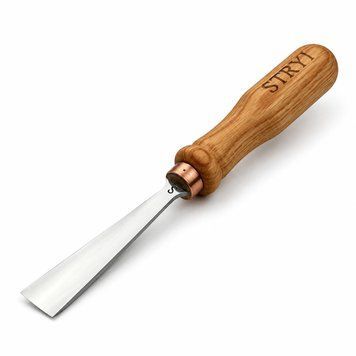
In a carver's kit, the 20 mm gouge holds a place of its own. The working edge is now wide enough that you're not just sketching a pattern but actually shaping the wood surface. This tool quickly takes off excess material, opens up the outlines of the relief to come, deepens the background and preps a blank for the next stage.
A 20 mm gouge suits blanks where a narrow tool would mean far too many passes. The larger the area you're working, the more the wide cutting edge pays off. You lay down the base of a composition faster, then switch to smaller tools to refine the pattern.
This width works for artistic and relief carving, decorative wooden panels, carved furniture parts, interior elements and dimensional compositions. Some models in this category are made for geometric and Hutsul carving. So the 20 mm gouge isn't a technique in itself — it's a working size that comes in at different stages of building a carved piece.
Where the 20 mm gouge saves time
One of the main jobs of a 20 mm gouge is shaping volume fast. Picture a blank that needs a relief ornament. First you have to free the future pattern from surplus wood — and doing that with a 5–10 mm gouge means a lot more passes.
- Semicircular profile — handy when a composition has plenty of rounded forms; use it to clear wide hollows between ornament elements or to shape smooth dips.
- Shallow-sweep gouge — better for taking wood down gradually, where the surface should move from one level to another with no sharp border.
- Short models — chosen for geometric carving, where you work set directions, repeating elements and a clear composition; the compact tool helps you feel the movement and control the edge position.
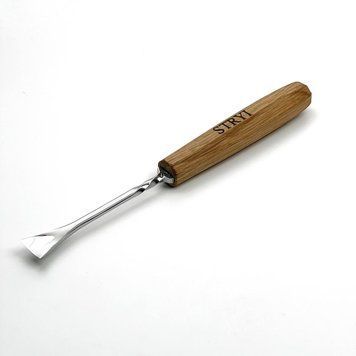
- Fishtail — worth keeping for more specific jobs. In deep carving, part of the surface can already block a straight approach to the point you need; the flared working end lets you reach into a hollow with fewer limits. For complex relief, this model can be far more useful than a standard 20 mm gouge.
A 20 mm tool lets you work a larger area and reach the needed step between background and raised elements sooner.
How to choose a 20 mm gouge
A few characteristics are worth weighing up:
- Profile. Semicircular for flutes and rounded clearing, shallow-sweep for smooth relief, special short versions for geometric techniques.
- Build. If the 20 mm gouge will see frequent, heavy use, look at the forged STRYI Profi models.
- Edge shape. Even and skew versions interact with the wood differently — which matters a lot in geometric carving.
- The specific operation. One profile suits heavy material removal, another finishing cuts. Don't expect a single 20 mm gouge to do everything equally well.
A wide gouge needs the blank held firmly. If the wood shifts during the cut, controlling pressure and direction gets harder. Clamp the blank before you start, and guide the 20 mm gouge without sharp jerks. Increase the depth gradually, especially on hard wood and areas where the grain direction changes.
Choosing a STRYI 20 mm gouge for your technique
STAMESKI brings together a range of STRYI 20 mm gouges, so you can match the tool to the job at hand. There are forged STRYI Profi models, semicircular and shallow-sweep versions, short AYU-STRYI Profi gouges for geometric carving and the specialised STRYI Maestro fishtail.
If you already know the profile you need, you can go straight to the right 20 mm gouge. If your kit is still coming together, it's wiser to first pin down the main operations: working the background, relief, geometric ornament or recessed areas. Worldwide shipping is available on every order.