


|
Quantity
|
Total
|
||
|
|
|||
|
|
|||
Drawknives for Fast, Controlled Wood Shaping
A drawknife is one of the most efficient hand tools for removing wood quickly while keeping direct control over every cut.
Held with both hands, the blade is guided across the workpiece to remove long shavings, reduce stock, strip bark and establish the basic shape of a wooden part. Unlike a power tool, a drawknife lets the woodworker immediately adjust cutting depth and direction according to the grain.
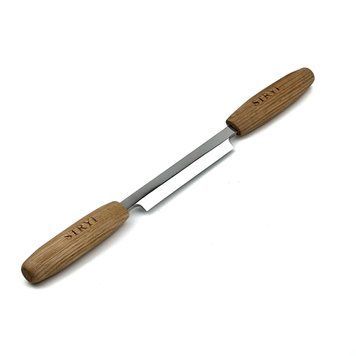
STRYI Drawknives are designed for demanding woodworking, greenwood shaping and timber work. The current range includes a 150 mm Bent Drawknife and a 130 mm Straight Drawknife, giving the user two different geometries for curved and flatter work.
What Is a Drawknife Used For?
A drawknife works particularly well when material needs to be removed faster than with a carving knife or chisel, but the user still wants more control than a powered cutting tool provides.
Typical applications include:
- debarking logs and greenwood;
- rough-shaping beams, blanks and timber;
- reducing stock before finer carving;
- shaping chair legs and other furniture components;
- following long curved surfaces;
- preparing wooden handles and structural parts;
- roughing the exterior of bowls and other large forms;
- flattening and refining timber before subsequent finishing.
The current STRYI drawknife collection specifically positions these tools for rapid stock removal, debarking, chair-leg shaping and roughing large curved forms.
Bent Drawknife vs. Straight Drawknife
The blade shape changes how the tool behaves on the workpiece.
Bent Drawknife – 150 mm
The Bent Drawknife has a slightly curved blade profile that helps the cutting edge follow rounded and changing surfaces.
It is a strong choice for:
- round logs;
- curved blanks;
- greenwood;
- sculptural forms;
- exterior bowl shaping;
- aggressive stock removal along natural contours.
The current STRYI 150 mm model uses a W1-7 high-carbon steel blade, 5 mm metal thickness, 58–60 HRC hardness, and oak handles finished with natural linseed oil. The distance between the handles is approximately 320 mm. STRYI specifies it for softwood, hardwood and greenwood.
Straight Drawknife – 130 mm
The Straight Drawknife is better suited to flatter work and controlled straight cuts.
Its geometry makes it useful for:
- flattening surfaces;
- shaping straight timber;
- squaring edges;
- removing bark;
- working narrower blanks;
- controlled pushing or pulling cuts.
Unlike the bent model, STRYI's straight version can be used comfortably in both pulling and pushing motions, which makes it particularly versatile for general carpentry work.
Which Drawknife Should You Choose?
Start with the shape of the workpiece.
Choose a Bent Drawknife when the surface itself is curved and you want the blade to follow that contour naturally.
Choose a Straight Drawknife when you are working primarily on flatter surfaces, straight timber or edges that need to remain predictable.
In practical terms:
Bent Drawknife = curved forms and contour shaping.
Straight Drawknife = flat surfaces, edges and general timber work.
For a workshop that regularly handles both logs and prepared timber, the two tools complement each other rather than duplicate the same job.
Built for Heavy Stock Removal
A drawknife experiences very different forces from a small carving knife.
Both hands apply leverage across the blade, and the tool may remove a wide shaving in a single pass. This requires a blade that remains stable rather than flexing excessively under load.
Current STRYI drawknife models use:
- W1-7 high-carbon steel;
- 5 mm metal thickness;
- 58–60 HRC hardness;
- oak handles finished with natural linseed oil;
- professional edge preparation before shipping.
The substantial blade construction is particularly useful when working hardwood, greenwood or large blanks where a lighter cutting tool would require many more passes.
How Cutting Angle Changes the Cut
A drawknife gives the user a high degree of control because cutting depth can be adjusted continuously through hand position and blade angle.
With the blade held for a lighter cut, the tool can take a thin shaving and gradually refine the surface.
A more aggressive cutting angle allows faster stock removal when roughing.
STRYI's current guidance for the straight drawknife also distinguishes between bevel-up and bevel-down use: bevel-up offers greater control over finer shavings, while changing the orientation alters how readily the edge enters the wood.
This ability to vary the cut is one of the reasons a drawknife remains useful from initial roughing through to relatively refined shaping.
Work with the Grain
Drawknives perform best when the user reads the grain rather than simply pulling harder.
If the edge begins to dive beneath the fibers or tear the surface, reducing the depth of cut or changing direction can produce a cleaner result.
For long workpieces, secure clamping is essential. A traditional shaving horse is especially effective because it holds the timber securely while leaving both hands free to control the drawknife. STRYI also recommends this setup in its current usage guidance.
Sharp and Ready to Work
A drawknife removes wood efficiently only when the edge is properly prepared.
A dull blade requires more pulling force and increases the tendency to tear fibers instead of producing a controlled shaving.
STRYI's current Bent Drawknife is supplied pre-sharpened with the cutting edge protected for shipping, so the tool can be put to work without first establishing a completely new edge.
Regular stropping and timely sharpening help maintain cutting performance and preserve the original blade geometry.
Made in Ukraine for Traditional and Modern Woodworking
Drawknives may be traditional tools, but their function remains highly practical in a modern workshop.
They provide rapid stock removal without a motor, excellent feedback through both hands and the ability to adapt every cut to the grain and shape of the workpiece.
Whether you are debarking greenwood, shaping a chair component, roughing a carved vessel or preparing structural timber, STRYI Drawknives provide the leverage and cutting control needed to shape wood efficiently by hand.
STRYI tools are manufactured in Ukraine, with the brand tracing its workshop production back to 2009.