

|
Quantity
|
Total
|
||
|
|
|||
|
|
|||
Leather Mallets for Controlled Wood Carving
When hand pressure is no longer enough, the right mallet gives a carver additional cutting force without the harsh impact of a steel hammer.
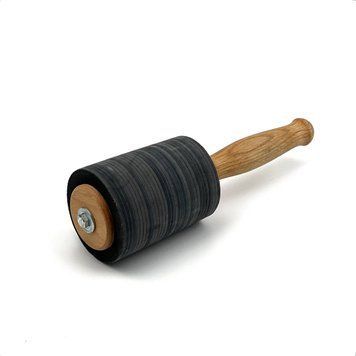
STRYI Leather Mallets are designed for striking the handles of carving chisels, gouges and heavy-duty sculpture tools. The striking head is built from round sections of genuine leather, creating a firm but more forgiving contact surface for repeated mallet-assisted carving. The handle is made from oak.
This makes a leather mallet particularly useful when roughing large forms, cutting deep relief or working dense wood where controlled impact is more efficient than hand pressure alone.
Why Choose a Leather Mallet?
A steel hammer delivers a very hard, concentrated impact. On a woodworking chisel with a wooden handle, repeated metal strikes can damage the handle unless the tool is specifically designed for that type of use.
A leather striking face behaves differently.
It transfers useful force to the chisel while providing a less aggressive point of contact. STRYI specifically positions its leather mallet as a tool for striking carving-tool handles during demanding sculpture work.
For the carver, this means:
- controlled power for deeper cuts;
- a more cushioned strike than direct steel-hammer contact;
- good feedback through repeated blows;
- less bounce during heavy carving;
- compatibility with large carving chisels and gouges;
- better control when gradually increasing the depth of a cut.
The current STRYI product description also emphasizes the mallet's low-bounce behavior during impact.
What Is a Leather Carving Mallet Used For?
The main purpose of this tool is mallet-assisted carving.
Typical applications include:
- roughing large wooden sculptures;
- driving heavy-duty carving chisels and gouges;
- cutting deep relief;
- removing substantial waste wood;
- establishing deep recesses and sculptural planes;
- working dense hardwood;
- carving architectural and decorative wood elements;
- shaping large forms where repeated hand pressure would be inefficient.
STRYI also offers its heavy-duty sculpture sets with a leather-mallet option, which confirms that this mallet is intended to work as part of a mallet-ready carving system.
75 mm vs. 90 mm Leather Mallet
STRYI currently offers two leather-mallet sizes:
75 mm Leather Mallet
A more compact option for regular sculpture work and situations where the user wants a balance between striking force and control.
90 mm Leather Mallet
A larger option for heavy-duty chisels, substantial roughing and large-scale sculpture where more striking mass is useful.
Both versions use a head constructed from round leather segments and an oak handle.
In practical terms:
75 mm = more maneuverability and controlled repeated strikes.
90 mm = greater impact for heavier tools and larger work.
The best choice depends not only on the hardness of the wood, but also on the size of the chisel and the amount of material you need to remove.
Match the Mallet to the Chisel
A leather mallet works best when its size matches the tool being driven.
A small carving gouge does not need the same impact as a wide Heavy-Duty Sweep #7 or #9 sculpture gouge.
For lighter carving tools, excessive force can make the cut harder to control. For reinforced heavy-duty tools, a larger mallet can transfer the required energy without forcing the user to make an exaggerated swing.
A useful rule is:
smaller tool → lighter, more controlled strike
larger heavy-duty tool → more mallet mass
STRYI's current guidance also notes that mallet use is especially appropriate for larger chisels and heavy-duty carving tools, while the chisel itself should be designed for mallet-assisted work.
Why Leather Works Well for Repeated Carving Strikes
Leather is dense enough to transfer force effectively, but its striking surface is not as hard as steel.
That combination makes it particularly suitable for repeated contact with wooden chisel handles.
The stacked-leather construction also gives the mallet a different feel from rubber. A leather mallet produces a firm, controlled strike and is particularly well suited to traditional sculpture and heavy chisel work.
STRYI describes its leather mallet as suitable for both small and large sculpture work and for the rough stages where greater cutting force is required.
Better Control During Heavy Carving
A mallet does more than simply make the cut stronger.
One hand controls the angle, direction and position of the chisel, while the other controls the force of the strike.
This separation is particularly useful when:
- approaching a defined boundary;
- increasing the depth of a relief gradually;
- shaping a large concave area;
- working around an important sculptural element;
- removing waste without driving the edge too far.
Several measured strikes usually give the carver more control than one excessively powerful blow.
Use It with Mallet-Ready Tools
Not every carving tool is designed for heavy striking.
Leather mallets are particularly well matched to the STRYI Heavy-Duty range, including sculpture gouges, flat chisels, V-parting tools and heavy-duty bent gouges.
STRYI explicitly recommends verifying that a chisel is designed for mallet use before applying additional impact.
This is important because fine palm tools and other lightweight detail tools are designed primarily for hand pressure rather than repeated heavy blows.
Simple Care for a Leather Mallet
Leather should be kept dry and stored away from prolonged moisture.
After use, wipe away wood dust and workshop debris and store the mallet in a dry place. Avoid striking sharp metal edges, nails or exposed cutting edges with the leather head, as they can damage the striking surface.
I would not add the source's recommendation to regularly apply leather conditioners or wax unless STRYI specifically approves a particular care method. Different treatments can change the firmness and surface characteristics of stacked leather, so the safer category-page advice is simply to keep the mallet clean and dry.
Built for Serious Carving
A leather mallet is especially useful when carving moves beyond light hand-pressure cuts into deeper, more demanding work.
Whether you are roughing a hardwood sculpture, driving a large gouge through difficult grain or establishing the depth of a relief, a STRYI Leather Mallet gives you additional cutting force while maintaining the controlled feel required for hand carving.
Current STRYI options are available in 75 mm and 90 mm sizes.